Table of Contents
Pharmaceutical manufacturing depends on water — not ordinary tap water, but Purified Water (PW) and Water for Injection (WFI) that meet stringent pharmacopeial standards. The quality of your water treatment system directly impacts product quality, regulatory compliance, and operational costs.
This guide walks you through everything you need to know before purchasing a pharmaceutical water system — from water quality standards to sizing, validation, and cost planning.
Why Pharmaceutical-Grade Water Matters
Water is the most widely used raw material in pharmaceutical manufacturing, appearing in up to 60% of final dosage forms. Impurities — bacteria, endotoxins, dissolved solids, or chlorides — can degrade active pharmaceutical ingredients (APIs), compromise product stability, and trigger regulatory action.
Major regulatory frameworks (FDA 21 CFR Parts 210/211, EU GMP Annex 1, and WHO Technical Report Series 970) mandate water systems that are designed, validated, and maintained to continuously produce water meeting predefined specifications.
Types of Pharmaceutical Water
| Type | Standard | Conductivity | TOC | Typical Use |
|---|---|---|---|---|
| Purified Water (PW) | USP <43>, EP 3.2.1, JP17 | ≤1.3 μS/cm | ≤500 ppb | Product rinsing, formulation, equipment cleaning |
| Water for Injection (WFI) | USP <123>, EP 3.2.1.6, JP17 | ≤1.1 μS/cm | ≤500 ppb | Final rinse for sterile products, injectable formulations |
| Pure Steam | FDA, EMA | N/A | N/A | Sterilization of equipment and containers |
How Purified Water Systems Work: The Treatment Train
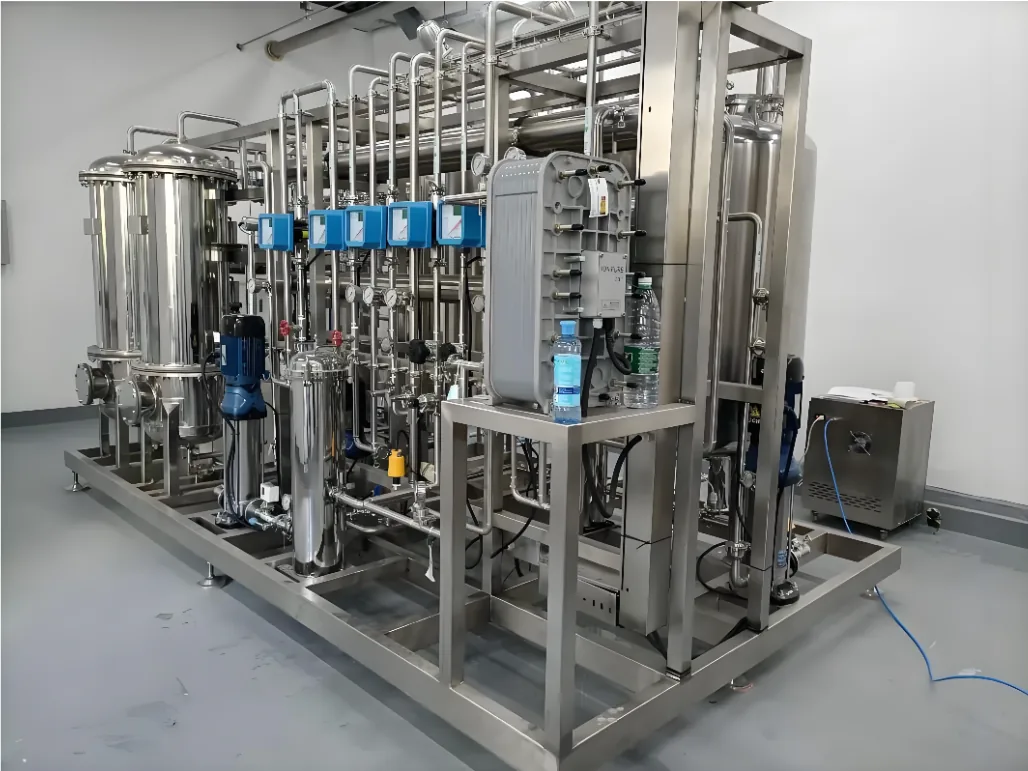
A typical pharmaceutical water treatment system follows a multi-stage process. Each stage targets specific contaminants:
Stage 1: Pretreatment
- Multi-media filtration — removes suspended solids, sediment, and turbidity
- Activated carbon filtration — removes chlorine, chloramines, organic compounds, and color
- Softening — removes calcium and magnesium ions to prevent scale formation in RO membranes
Stage 2: Reverse Osmosis (RO)
RO is the core purification step, removing 95–99% of dissolved ionic and organic contaminants. A properly sized RO system operating at 75% recovery can produce PW at 1–5 μS/cm conductivity. Dual-pass RO is often used when ultra-low conductivity is required.
Stage 3: Electrodeionization (EDI)
EDI polishes RO water by removing residual ionized species using ion exchange resins and electrical current — no chemicals required. This brings conductivity below 0.5 μS/cm and reduces operating costs versus traditional ion exchange regeneration.
Stage 4: Ultraviolet Disinfection
UV lamps at 254 nm provide continuous microbiological control by damaging bacterial DNA. For WFI systems, 185 nm UV (TOC reduction) and 265 nm UV (disinfection) are often combined.
Stage 5: Storage & Distribution
Treated water is stored in sanitizable stainless steel tanks (typically 316L) with continuously recirculating loops maintained at ≥80°C (hot loop) or ambient temperature with UV (ambient loop). Loop velocity must be ≥1.0 m/s to prevent biofilm formation.
Key Specifications to Verify
| Parameter | Acceptance Criteria | Measurement |
|---|---|---|
| Conductivity | ≤1.3 μS/cm (PW) | Online conductivity meter, continuous |
| Total Organic Carbon (TOC) | ≤500 ppb | Online TOC analyzer, continuous |
| Total Aerobic Microbial Count | ≤100 CFU/mL (PW) | Weekly sampling per pharmacopeia |
| Endotoxins (WFI) | ≤0.25 EU/mL | LAL test, batch or continuous |
| Loop temperature | ≥80°C (hot) / ambient ±2°C (cold) | Online PT100 sensors |
| Flow velocity | ≥1.0 m/s (recirculation loop) | Flow meter monitoring |
How to Size Your System
System capacity is determined by your peak hourly demand plus a safety margin. A common formula:
Daily water need (L/day) ÷ operating hours × 1.3 safety factor = minimum hourly flow rate
For most pharmaceutical plants, YohoAI recommends a system sized for 20–25% above peak demand to accommodate validation testing, CIP cycles, and future expansion.
Validation Requirements
Pharmaceutical water systems must undergo full IQ (Installation Qualification), OQ (Operational Qualification), and PQ (Performance Qualification) as part of regulatory submissions. YohoAI provides complete validation documentation packages including:
- System design specifications (SDS)
- Material and weld certificates (EN 10204 3.1)
- Validation protocols and acceptance criteria
- PQ report with 90-day continuous monitoring data
- Standard operating procedures (SOPs) for operation and sanitization
Common Mistakes to Avoid
Lessons from 200+ Installations
1. Under-sizing the RO — leads to frequent CIP cycles and downtime
2. Ignoring pretreatment — RO membrane fouling dramatically increases operating cost
3. Low loop velocity — promotes biofilm, triggering microbial excursions
4. Skipping PQ duration — 90-day PQ is required, not optional, for regulatory filings
5. Single-point-of-failure monitoring — redundant sensors prevent false compliance alarms
Operating Cost Overview
A well-designed PW system for a medium-scale pharmaceutical plant typically consumes:
- Feed water: 3–5 L of municipal water per liter of purified water produced
- Electricity: $0.05–$0.15 per liter of PW (varies by energy cost and system efficiency)
- Pre-filter replacement: Every 3–6 months ($200–$800 per change)
- RO membrane replacement: Every 3–5 years ($3,000–$10,000 per set)
- Annual validation maintenance: $2,000–$8,000
YohoAI Purified Water Systems
YohoAI's PW series includes standard capacities from 250 L/hr to 10,000 L/hr, with custom systems available for larger facilities. All systems feature dual-pass RO + EDI configuration, 316L stainless steel storage, continuous online monitoring (conductivity + TOC + flow), and complete IQ/OQ/PQ documentation packages validated for FDA, EU, and WHO markets.
Need a Custom Purified Water System Quote?
Tell us your daily water demand and certification target — our engineers respond within 24 hours.
Request Technical Proposal WhatsApp Us